Overview
The Cuddl project provides a cross-platform API for writing user-space device drivers that works under Linux, Xenomai, and RTEMS.
Status
Xenomai and standard Linux systems are fully supported. Support for RTEMS has not been implemented at this time.
Background
Before we dive into the details of the software, let us take a moment to discuss the architecture of device drivers.
Conventional UNIX Device Driver Architecture
The UNIX philosophy could perhaps be summarized as everything is a file. Given the UNIX mindset, it should come as no surprise that under UNIX, user-space applications access hardware devices through special device nodes that appear in the filesystem tree. Applications can transfer data to and from hardware devices using these device nodes in the same way that they read and write standard data files. The user interface for other operations (such as device configuration or special functions) is not as standardized, and usually involves device-specific ioctl() calls.
UNIX device drivers are typically implemented entirely in kernel space, and as such, are only accessible to user-space applications via system calls provided by the operating system. This level of abstraction provides a great deal of portability between POSIX (the UNIX standard) operating systems, and also between hardware devices, provided that the hardware devices have similar functionality. It is worth noting, however, that although POSIX applications can be fairly portable, kernel-space device drivers are usually not.
UNIX device drivers typically contain code to handle device interrupts, code to configure and control the device using memory-mapped I/O registers, and code to create and interact with device nodes that expose the hardware to user-space applications. The interrupt handling code is typically broken up into a top half and a bottom half. The top half executes quickly, handling the urgent tasks with interrupts disabled, and then it schedules the bottom half to be executed a bit later, with interrupts enabled.

Advantages of the conventional UNIX device driver architecture:
Devices are exposed via a familiar file-like interface.
Application code is often portable to other POSIX-compliant operating systems.
Application code is often portable between devices with similar functionality.
No extra user-space libraries are required.
Disadvantages of the conventional UNIX device driver architecture:
Clunky interface for non-standard devices or functions.
Application code is not portable to non-POSIX systems.
Driver code is usually not portable.
Driver development must be done in kernel space, which requires admin privileges and makes debugging more difficult.
Loading new drivers requires special procedures and admin privileges.
In some cases (especially for non-standard functionality), kernel-driver and user-space code may need to be kept in-sync.
User-Space Device Driver Architecture
The user-space device driver concept attempts to address some of the disadvantages of kernel-space device drivers by moving as much code into user space as possible. Depending on the particular operating system, some aspects of device-driver functionality (such as interrupt handling) may only be available in kernel space, so in those cases a small kernel device driver stub must be implemented in addition to the user-space device driver code. Typically, the top half of the interrupt handler must be implemented in kernel space. Sometimes it is also convenient to detect, map, and export the a device’s registers from kernel space.
Because drivers are implemented in a user-space library, and not as part of the kernel, user-space device driver architectures typically implement a functional or object-oriented end-user API instead of using the POSIX file convention. Depending on your preferences, and on the type of device you are dealing with, this may be an advantage or a disadvantage.

Advantages of the user-space device driver architecture:
Custom object-oriented or functional end-user APIs can be implemented.
Device drivers can be implemented in any programming language.
Application code can be made portable across many (even non-POSIX) operating systems via a compatibility layer.
Devices with non-standard functionality can be more easily accommodated.
Most of the driver code should be portable across many operating systems.
The majority of driver development is done in user space.
The kernel device driver stub code is minimal, and its interface is simple, which reduces the need to change the kernel-space code. This simplicity makes it easier to keep the user-space and kernel-space code in sync.
Disadvantages of the user-space device driver architecture:
Non-standard approach, so it is less widely known and understood.
Not quite as fast as native drivers.
A POSIX file-like interface is not practical with this approach, so user-space devices cannot work in the same way as OS-provided devices on POSIX systems.
Some sort of wrapper would be required to write applications that could use POSIX device nodes and user-space devices interchangeably.
Applications must link against a user-space device driver library.
If these concepts are new to you, it may be helpful to read this introductory article on user-space device drivers, and possibly the Linux UIO documentation as well.
Architecture
The purpose of the Cuddl project is to make writing portable user-space device drivers as easy as possible. This is done by providing a common set of user-space and kernel-space programming interfaces that hide the operating system and platform-specific implementation details, as shown below.
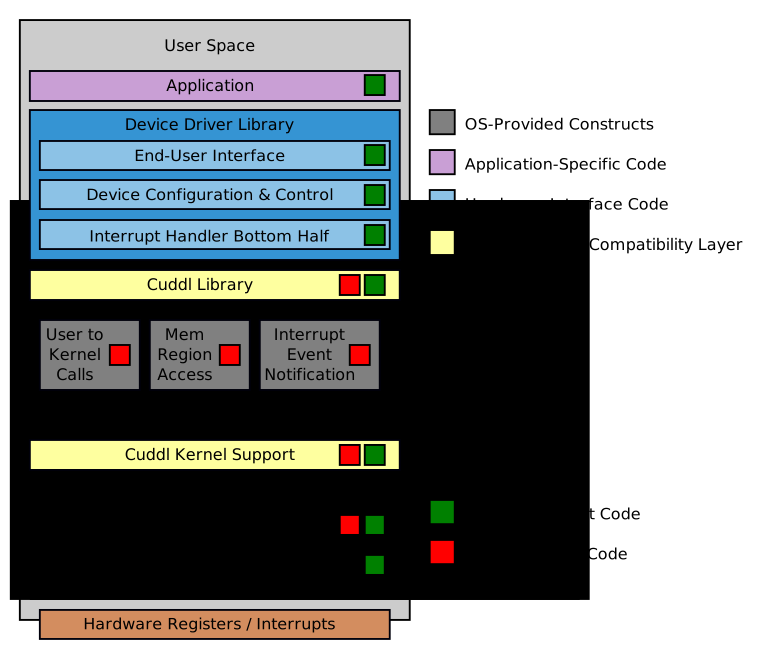
As you can see from the diagram above, most of the OS-dependent code is provided by Cuddl. This allows driver developers to focus on writing portable hardware-interface code without having to wade through a lot of platform-specific details. Driver developers must implement an OS-dependent “shell” for their kernel driver stubs, but the hardware-specific code should be fairly portable.
In addition to memory region mapping and interrupt event notification functionality, Cuddl also provides an interface to request and query the hardware peripherals that have been registered.
Cuddl currently aims to support the Linux, Xenomai, and RTEMS operating systems, and the implementation details are a little different for each one.
Xenomai
One thing to note is that the Xenomai implemention is a superset of the Linux implementation, meaning that real-time Xenomai applications and standard Linux applications may both access Cuddl devices.
The following software-stack diagram shows how the various pieces of software come together for the Xenomai implementation.

As you can see from the diagram, this particular implementation is built on top of the Xenomai UDD and Linux UIO frameworks.
Linux
The Linux implementation is very similar to the Xenomai implementation described in the previous section. The software stack diagram is applicable if you ignore the Cobalt-related blocks in the diagram.
RTEMS
RTEMS support has not yet been implemented.